

Local Support Services
A mens mental health group based in Warrington, ran by men with lived experience.There’s no referral, no form, and no pressure to share. Talk if you’re ready, stay quiet if you’re not, and simply sit with a brew in a room where you don’t have to pretend.
They run various free, relaxed sessions throughout the week such as :
| Session | Location | Time | Frequency |
|---|---|---|---|
| Brew and Banter |
Whitecross community centre |
7:30pm - 9:00pm | Every Thursday |
| Pool and Snooker social | 147 Club Norman Street | 12:30pm | 2nd Friday of every month |
| Wellbeing Wednesday | The Living Well Hub | 1:30pm - 3:30pm | 2nd & 4th Wednesday of every month |
| More than a Breakfast Club | Whitecross community centre | 10am | 1st Sunday of the month |
Find out more on their website: More Than Men – A space for real conversations
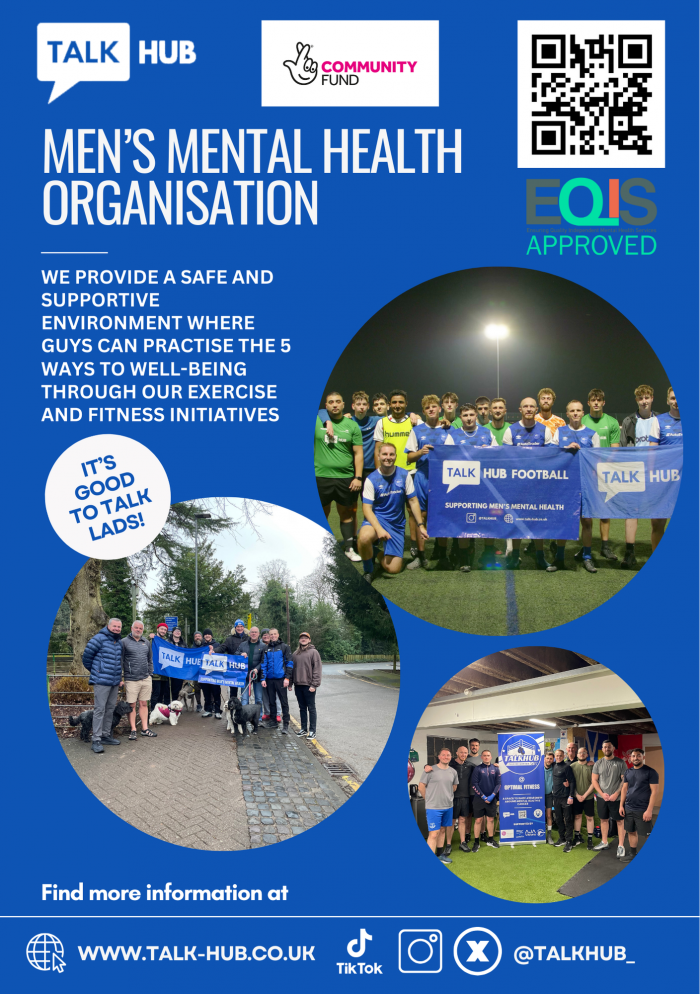
A non - profit mens mental health organisation providing physical activities such as boxing , football  and walks all centered around their motto of 'it's good to talk lads'.
Follow Talkhub on instagram @talkhub_ to stay up to date with available sessions or email Jay at talkhub@outlook.com to find out more.
| Session | Location | Time | Frequency |
|---|---|---|---|
| Boxing | Optimal fitness boxing Gym WA4 1AY | 7pm - 8:30pm | Every Wednesday |
| Football | Orford Jubilee Warrington | 7:30pm - 9:30pm | Most Fridays |
Cost : £2 per session
Offload is a mental fitness and wellbeing programme ran by The Warrington Wolves Foundatio![Offload Logo-03[73].png](/application/files/thumbnails/xs/4317/6735/2113/Offload_Logo-0373.png) n in partnership with Rugby League Cares. The free ,weekly sessions are designed to prevent mental health problems by supporting men to look after their own mindsets and recognise when they or others require further support.
n in partnership with Rugby League Cares. The free ,weekly sessions are designed to prevent mental health problems by supporting men to look after their own mindsets and recognise when they or others require further support.
Sessions run every Tuesday, 18:30 at The Halliwell Jones Stadium.
There’s no need to sign up in advance, just show up.
Find out more : OFFLOAD
Designed to help anyone registered with a Warrington GP to deal with common mental  health problems by talking to a trained professional about your thoughts, feelings and behaviours. These may include depression,anxiety, panic disorder, phobias, obsessive-compulsive disorder (OCD) or post-traumatic stress disorder (PTSD)
You can self-refer to the service online or by calling 01925 401 720.
Find out more on their website : NHS Warrington Talking Therapies
Healthwatch are committed to ensuring everyone in our community has access to the support they need to live well. They are are on a mission to understand better the experiences of men in Warrington: how they access support, what barriers they face and what improvements they feel are needed.
Whether you've used services or not, your insights will help shape future care and ensure services are inclusive, accessible, and responsive to men's needs. Your feedback will be used to inform local providers, commissioners, and decision-makers, helping to improve services for men across Warrington.
Click here to have your say or vi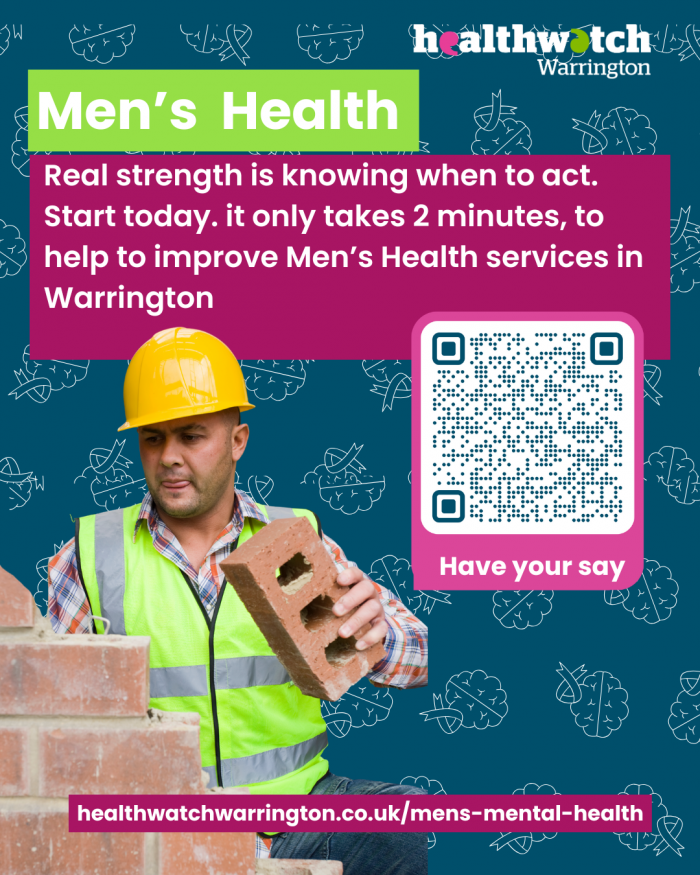 sit Men's Mental Health | Healthwatch Warrington to find out more.
 Warrington Speak Up is an independent advocacy organisation commissioned to provide a range of advocacy services, projects and consultation initiatives for people with dementia, learning diasabilities, mental health and young people.
The Mental Health services they currently provide are :
| Session | Location | Time | Frequency |
|---|---|---|---|
| PAUSE - community listening space drop in |
The Gateway WA1 1SR |
Monday 10:30am - 1:30pm Wednesday 12:30pm - 3:30pm Friday 10:30am - 1:30pm |
Every week |
| Walk and Talk | Meet at the Golden gates then back to PAUSE for a brew | 2:30pm | Every 2nd & 4th Thursday of the month |
| Bipolar Personality Disorder (BPD) peer support drop in | PAUSE space at The Gateway | 1:30pm - 3pm | Every Friday |
Mens Health
Prostate cancer is the most common cancer in men in the UK. 1 in 8 will be diagnosed in their lifetime and over 50,000 new cases occur each year. Risk increases with age (especially over 50), family history, and Black ethnicity.
Prostate cancer symptoms only happen when the cancer is large enough to press on the tube that carries the urine from the bladder (urethra). If the cancer is in the early stage it may not cause any symptoms.
The symptoms of benign (non-cancerous) prostate conditions and prostate cancer are similar. They can include:
- needing to pee more often than usual, especially at night
- difficulty peeing – for example, a weak flow or having to strain to start peeing
- feeling like you have not completely emptied your bladder
- an urgent need to pee
- blood in your urine or semen
- rarely, pain when peeing or ejaculating
When to see a GP?
- If you're over 50 years old, come from a Black ethnic background or have a history of prostate cancer in your family and you're worried about your risk of prostate cancer
- If you're having trouble peeing or other symptoms of prostate cancer
Visit Prostate cancer - NHS for more.
The NHS Health Check is a crucial service for men aged 40 to 74, offering a free check-up of cardiovascular health.
It can tell you whether you're at higher risk of getting certain health problems, such as:
During the check-up you'll discuss how to reduce your risk of these conditions.
If you're aged 40 to 74 and do not have a pre-existing health condition, you should be invited to an NHS Health Check by your GP every 5 years.
If you think you are eligible but have not been invited, or are over due a Health Check , contact your GP surgery direct.
Click here to read more.
Reaching out.
If you think someone you know could be struggling, reaching out to them could help them realise that they are valued and someone cares. If you’ve noticed someone has gone quiet in a group chat or you haven’t heard from them in a while, reach out and check in. A simple message can mean a lot to someone who is going through a difficult time.
Click here to visit the Samaritans website for tips on how to start a conversation and how to be a good listener Little tips for helping someone open up when something’s up | Samaritans
Asking Twice.
New research released by Time to Change, a campaign tackling mental health issues stigma, reveals that over three quarters (78%) of us would tell friends and family we are "fine" even if struggling with a mental health problem. To tackle this, we are urging people to ‘Ask Twice’ if they suspect a friend, family member, or colleague might be struggling with their mental health.
The simple act of asking again, with interest, shows a genuine willingness to talk and listen. #AskTwice
See video below for more details.
